
With Tesla Roadster debut, Elon Musk shows "flying cars are real" |
With Tesla Roadster debut, Elon Musk shows "flying cars are real" — but the Waco demonstration leaves major questions unanswered |
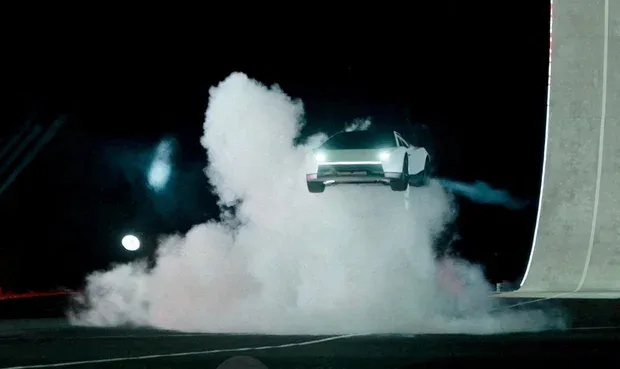
With Tesla Roadster debut, Elon Musk shows "flying cars are real" — at least for a few dramatic seconds at a Texas demonstration that raised nearly as many questions as it answered.
At a SpaceX facility in the Waco area on October 15, the long-delayed electric sports car raced along an overhead ramp, launched into the air, rotated and landed on its wheels.
It was a striking moment for a vehicle that has spent years generating more anticipation than deliveries.
But the demonstration did not show a car cruising above traffic, carrying passengers through a neighborhood or making a routine trip between destinations.
That distinction matters well beyond the spectacle in Waco, Texas, where a rocket-company setting gave the unveiling an unmistakably futuristic feel.
Elon Musk said the new Roadster used ultra-high-pressure air tanks to propel itself off the ramp.
He also acknowledged that the ambitious technology might not work as intended, even as he projected production for 2028.
A successful stunt is not the same thing as an approved flying car.
The demonstration put the relationship between Tesla and SpaceX at the center of the story, combining an electric sports car with propulsion ideas associated with Musk's rocket business.
For Tesla, the result was an attention-grabbing return for the next-generation Roadster, a model whose lengthy wait has tested the patience of enthusiasts.
For anyone imagining a commute above Central Texas roads, the practical details remain far less thrilling.
Tesla has not announced a price for the flying version, and the company says that model is not approved for public road use.
Prospective buyers can place a $5,000 reservation for a non-flying Roadster, while the proposed Rocket model with a full flight system is described as invitation-only.
A limited Thrust version has also been described, though reservations for it are not available.
Those differences make the most sensational version of the car the least accessible one.
There is also the unresolved question of who would oversee a vehicle designed to leave the ground.
The National Highway Traffic Safety Administration generally oversees vehicle safety, while the Federal Aviation Administration has said the Roadster as described does not meet its definition of an aircraft.
That does not settle how a production model with a flight system would be reviewed or where it could operate.
Regulatory uncertainty could prove as consequential as the engineering challenge.
The electric sports car is unlikely to become a high-volume product, but its promotional value may be substantial.
A high-profile Roadster demonstration draws attention to Tesla's engineering ambitions, even if it offers little immediate evidence of future sales.
That is the tension at the heart of the Tesla Roadster debut: the launch delivered a memorable image, not a finished transportation system.
Flying car regulation, public-road approval and repeatable performance still stand between the Waco demonstration and anything a driver could realistically use.
For now, the Roadster's leap is best understood as a bold proof of ambition, with the harder proof still to come. |
0 Comments
Join the conversation
Be the first to comment
Share your thoughts above.